Home/Armadillos
Armadillo Removal in Florence
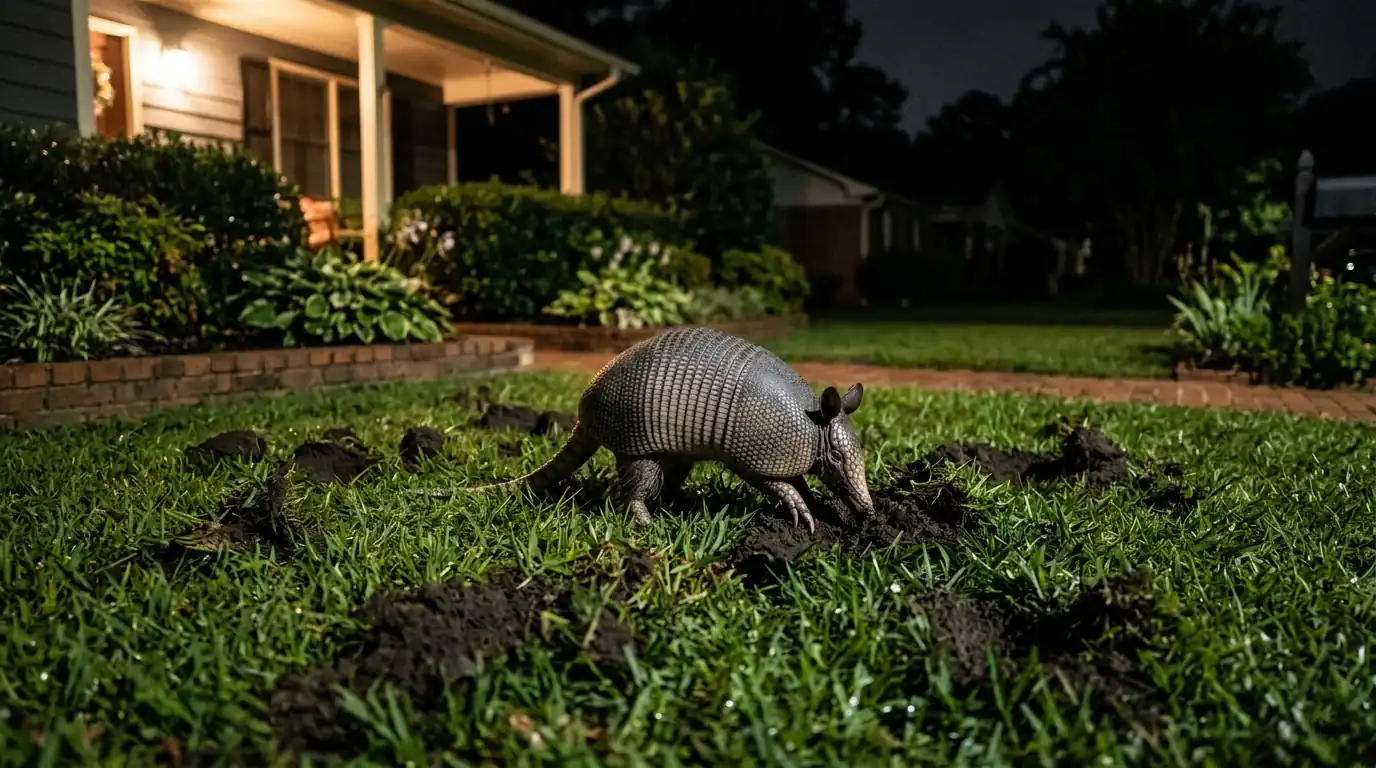
An armadillo can turn a good lawn over in a single night, and the burrows go under concrete.
Armadillos are a relatively recent arrival in South Carolina compared with the Gulf states, and a lot of people here have simply never dealt with one. Sandy Pee Dee soil suits them very well. If your lawn is developing shallow cone-shaped holes overnight and you have ruled out moles, this is very likely what you have.
How you know it is armadillos
- Dozens of shallow cone-shaped holes across the lawn, appearing overnight
- Lifted or rolled-back turf where they have rooted for grubs
- A burrow entrance about 7–10 inches wide beside a slab, driveway or foundation
- Damage that reappears night after night in a slightly different patch
Why it matters
- Burrows undermining driveways, patios, slabs and foundation edges
- Repeated and expensive lawn damage
- Armadillos are one of the few wild carriers of the bacterium that causes leprosy: a genuine if low reason to avoid handling them
Somebody has to look at the property to answer that. How many entry points or burrows there are, how hard they are to get at, and whether young are present is what sets the price, and none of it can be judged from a description. Send us your address and licensed local operators will quote the inspection and the work. Request free quotes →
How removal actually works
Armadillos are poor candidates for bait trapping; they are after live grubs, not bait. Removal relies on directional trapping along travel routes and burrow entrances, then exclusion fencing dug in and angled outward.
Timing
Year-round in the Deep South, worst in warm wet spells when grubs are near the surface.
What it costs
Removal is only part of it. Where an animal has been in an attic for a while, the contaminated insulation and droppings are usually the larger bill: what attic restoration involves →
What South Carolina law requires
South Carolina works through depredation permits rather than a single operator licence: an SCDNR depredation permit is required to trap or take wildlife out of season. Licensed wildlife control operators can apply for and work under depredation permits that are not available to the general public, which is what lets them handle species (alligators among them) that a property owner cannot legally touch. Animals taken under a depredation permit may not be relocated, sold, traded, exchanged or bartered. Full South Carolina rules →
Armadillo questions
How much does Armadillo removal cost in Florence?
$250 – $550 typical. The spread comes down to how many entry points there are, how hard the roof or crawlspace is to reach, and whether young are present. Anyone quoting a firm price before seeing the property is guessing.
How quickly can someone come out?
Most armadillos calls in Florence are handled within a day or two. If an animal is loose inside your living space, or there is a bite or scratch involved, say so when you make contact; that changes the priority.
Can I just do it myself?
Sometimes, legally speaking. But the two things that go wrong are sealing an entry point while young are still inside, and handling an animal that turns out to be a rabies vector. Both are expensive mistakes, and one is dangerous.
Is there a wrong time of year for this?
Year-round in the Deep South, worst in warm wet spells when grubs are near the surface.
Request free quotes
Licensed wildlife operators covering Florence will contact you directly. There is no charge and no obligation.